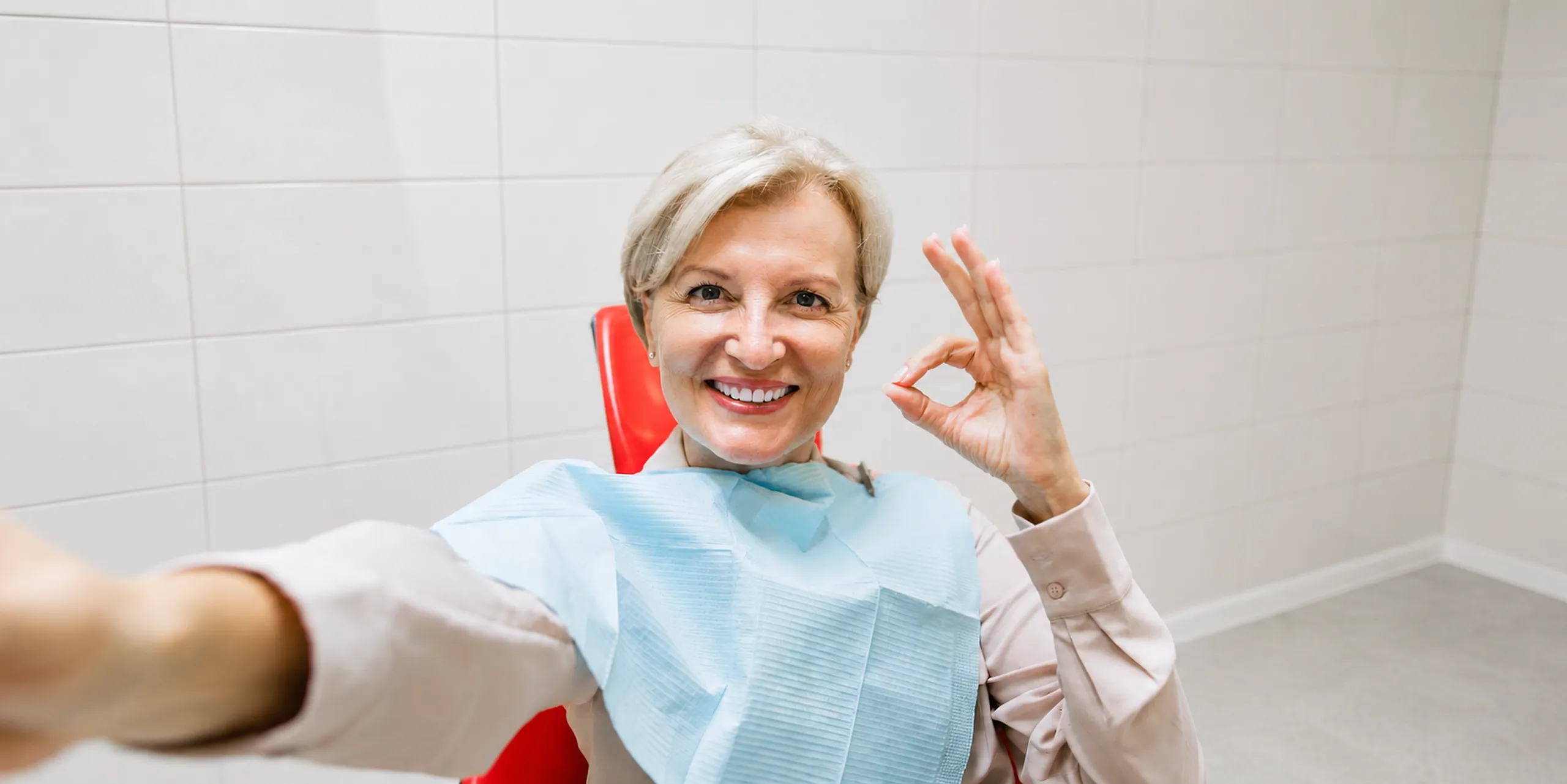
The right dentist for your smile
Transform your smile with aesthetic dentistry — expert care, the latest techniques and premium materials.
Transform your smile with aesthetic dentistry — expert care, the latest techniques and premium materials.
Hollywood Smile is a complete aesthetic transformation — several treatments designed together so the whole smile works. The result is the natural, even smile you see on a red carpet, but built around your face and your teeth.
Every Hollywood Smile here starts with a thorough consultation and digital planning. You and the dentist decide the shape, size and shade before anything is done. Treatment usually means veneers, crowns, whitening or a combination, depending on the state of your teeth.
The result is permanent, natural-looking and built to last for years. We use only premium zirconia and ceramics from established European labs.
For a Hollywood Smile we work exclusively with zirconia crowns. Zirconia is an exceptionally strong, biocompatible material that, unlike ordinary ceramic, has no metal core — light passes through it much as it does through natural enamel.
That is why the result never looks artificial. We match the colour, the shape and the translucency to your face and to the rest of your teeth.
A Hollywood Smile is the answer if you are bothered by:
During the consultation you and the dentist will work out whether a Hollywood Smile really is the best route for you — and if it is not, we will suggest an alternative.
Zirconia crowns are designed to last for years. With ordinary care — regular brushing at home and dental hygiene at the clinic — they hold their colour and shape for a long time.
Zirconia does not take on stain from coffee, tea or red wine the way natural enamel does.
What exactly does it involve?
It depends on your teeth. Most often veneers or crowns on the front teeth, whitening, and small adjustments to shape. The dentist sets out the exact plan after the first examination.
How many visits does it take?
Usually three to five over a few weeks.
Is it painful?
No. Everything is done under local anaesthesia. After the teeth are prepared they can be sensitive for a few days.
How long does it last?
Looked after properly, 10 to 15 years and sometimes longer.
Can I pay in instalments?
Yes. For an investment of this size we offer financing — ask us for the details at the consultation.
All on 4 and All on 6 are for patients who have lost most or all of their teeth. Instead of a removable denture you get a fixed, stable set anchored on four or six implants — no adhesives, no movement, no compromises.
All on 4 uses four implants and suits most patients with no remaining teeth. All on 6 adds two more for demanding cases. We use both only with Straumann and MegaGen implants.
With precise 3D guidance we can often place implants for patients who would not have enough bone for conventional implants — without extensive grafting.
Implants: titanium implants from Straumann or MegaGen — two of the most respected names in implantology. Titanium is biocompatible and fuses naturally with bone.
The supporting structure: a titanium bridge that forms the solid base of the whole arch.
All on 4 uses four implants and is the right answer for most patients with a fully edentulous jaw.
All on 6 adds two more implants. We recommend it for more demanding cases — where biting forces are higher, or where the load is better spread across more points.
Which option suits you better is something we decide after the 3D scan. The scan is free with us, as is the treatment plan.
Consider this option if:
That last point is exactly why many patients come to us. With 3D guidance we can place implants even where there is less bone — often without extensive bone grafting.
Fixed teeth on implants behave like your own. You can eat without restriction, nothing has to come out or be glued in, and you need not worry about anything shifting while you talk.
Care is straightforward: ordinary cleaning at home and regular dental hygiene at the clinic.
What is the difference between the two?
All on 4 carries the whole arch on four implants — the more affordable option and enough for most cases. All on 6 adds two implants for extra stability.
Do I need a bone graft first?
Not always — placing the implants at an angle makes use of bone that would not be enough for conventional implants.
How long does the whole treatment take?
Three to six months from the first consultation to the final teeth. A temporary set can go on the day of surgery.
Is the surgery painful?
It is done under general or local anaesthesia — you feel nothing during it. Afterwards there is usually swelling and tenderness for five to seven days.
Who is it not suitable for?
It is not suitable with uncontrolled diabetes, heavy smoking or serious systemic illness — we assess that at the free consultation.
An implant is the closest modern dentistry gets to a natural tooth. A titanium screw is placed in the jawbone and, once healed, acts as the root for a zirconia crown.
Unlike a bridge, an implant puts no load on the neighbouring teeth — it stands on its own. We work only with Straumann and MegaGen, two of the most reliable systems on the market with a long clinical record.
The whole process — consultation to final crown — is handled by one team in one place. No being sent from practice to practice.
A conventional bridge requires grinding down two healthy neighbouring teeth, which then act as abutments. An implant stands entirely on its own — the neighbouring teeth are left untouched.
An implant has a second advantage a bridge cannot offer: it loads the bone. After a tooth is lost the bone in that spot gradually recedes. An implant halts that loss, because it carries chewing force into the bone much as a natural root does.
An implant is designed to last decades. The key to that lifespan is care: thorough hygiene at home and regular check-ups with dental hygiene at the clinic.
An implant cannot decay, but the surrounding gum and bone need the same attention as they would around your own teeth.
Both systems are good and we use both every day.
Straumann is a Swiss brand with the longest clinical history on the market and extensive research behind it. It is the premium choice.
MegaGen is a South Korean system offering very good value for money while staying highly reliable.
Which system we recommend depends on the state of your bone, the position of the tooth and your budget. We will talk the difference through at the consultation.
Consider an implant if:
We assess suitability from the 3D scan. If there is not enough bone, the answer is usually bone augmentation — which we also carry out here.
Does placing an implant hurt?
It is done under local anaesthesia — you will not feel pain while it is placed. Mild swelling and tenderness for two to four days afterwards is normal.
How long from implant to crown?
Three to six months — the implant has to heal and fuse with the bone (osseointegration).
What if I do not have enough bone?
In many cases we can build it up with a graft or a sinus lift. We propose the exact approach after a free 3D scan.
Are implants worth it later in life?
Yes — age is not a contraindication. Implants are placed successfully in patients in their seventies and eighties.
How do I look after an implant?
Exactly as you would your own tooth: brush twice a day, use interdental brushes and come for regular hygiene appointments. Hygiene is what decides how long an implant lasts.
A veneer is a thin porcelain or zirconia shell bonded to the front of the tooth. It changes colour, shape and size with minimal intervention in the tooth itself — ideal for teeth that are healthy but not how you want them to look.
A crown covers the whole tooth, which is what you want when the tooth is badly damaged or has had root canal treatment. We use zirconia crowns only — biologically neutral, extremely strong and indistinguishable from a natural tooth.
Both are planned digitally, so you can see the result before anything is done — through a wax-up model or a digital simulation.
A veneer is a thin shell on the front surface of the tooth. It suits a tooth that is essentially healthy but does not look the way you want — colour, shape, a small gap or a slight rotation.
A crown covers the whole tooth. We choose one when the tooth is more heavily damaged, after root canal treatment, or when a large old filling has weakened it.
Put simply: a veneer solves appearance, a crown solves appearance and strength.
Veneers: porcelain or zirconia. Both materials transmit light much as natural enamel does, so the result never looks flat or artificial.
Crowns: zirconia only, with no metal core. Zirconia is biologically neutral, exceptionally strong, and does not differ in colour from the teeth around it.
For front teeth translucency matters most of all — and that is exactly why we do not use metal-ceramic for aesthetic work.
A wax-up model or a digital simulation means you are not deciding the final shape and proportions blind.
With a temporary composite veneer you can even try the new shape in your mouth and get used to it before committing. If something is not right, we change it before the permanent work is made.
Zirconia and porcelain work is designed to last for years. It does not take on stain from coffee, tea or red wine the way natural enamel does.
Care is the same as for your own teeth — thorough hygiene at home and regular dental hygiene at the clinic. If you grind your teeth we recommend a night guard to protect the work.
Veneer or crown?
A veneer covers only the front surface and needs minimal preparation. A crown covers the tooth on all sides, which suits heavier damage.
Do the teeth have to be prepared first?
Usually yes, but only slightly — typically 0.3 to 0.5 mm. Ultra-thin veneers need even less.
How long do veneers last?
Ceramic and zirconia veneers last 10 to 20 years when looked after.
Are zirconia crowns better than metal-ceramic?
In most cases yes — zirconia is stronger, more biologically neutral and looks better, with no dark line at the gum.
Will I see the result before the treatment?
Yes. Before we start we prepare a wax-up model or a digital simulation, so you approve the shape and the shade in advance.
A bridge is the classic solution when one or more neighbouring teeth are missing. Two crowns on the adjacent teeth carry a replacement tooth between them, cemented in place and working as one piece.
A bridge is quicker and cheaper than an implant, with no surgery and no waiting to heal. But the healthy teeth either side have to be prepared, and that cannot be undone — so where an implant is possible, we suggest considering it as the longer-term answer.
We make bridges from premium materials — zirconia and all-ceramic — for the best result both to look at and to chew on.
A bridge is quicker and more affordable. It needs no surgery and no months of waiting to heal — it is usually finished within a few visits.
An implant is the longer-term answer. It puts no load on the neighbouring teeth while it does load the bone, which stops the bone receding where the tooth is missing.
The key difference: a bridge means grinding down two healthy neighbouring teeth. That cannot be undone. So wherever it is possible, we suggest considering an implant.
A bridge still has its place, though — for instance when the neighbouring teeth are already damaged and would need crowns anyway, or when implants are ruled out on medical grounds.
Zirconia bridge — no metal core, transmits light much like a natural tooth. The best choice for front teeth, where appearance is everything.
Metal-free ceramic — an equally attractive alternative with excellent optical properties.
Metal-ceramic — a proven and more affordable option, suited above all to back teeth where appearance is not the first concern.
Which material suits you depends on where the bridge sits and what you prefer. We will go through it together at the consultation.
Looked after properly, a bridge lasts many years. The critical spot is the space beneath the artificial tooth — plaque gathers there and ordinary floss will not reach it.
That is why we recommend special aids (superfloss or interdental brushes) and regular dental hygiene at the clinic. We will show you how, as soon as the bridge is fitted.
How long a bridge lasts depends above all on the health of the abutment teeth — which is precisely why thorough hygiene around them matters so much.
Bridge or implant?
A bridge needs no surgery and is finished sooner, in two to three weeks. An implant stands alone, puts no load on the neighbouring teeth and stops the bone receding.
Does fitting a bridge hurt?
No. Preparing the adjacent teeth is done under local anaesthesia.
How long does it take?
Usually two or three visits over two to three weeks.
Can a bridge come loose?
Properly cemented and under normal use, no. If it does work loose, bring it to the dentist as soon as you can.
How do I clean under a bridge?
With superfloss or an interdental brush that passes under the pontic. We show you how when the work is fitted and check it at your hygiene appointment.
Bone grafting adds material to the jawbone — your own, donated or synthetic. The point is to restore volume and density where a tooth has been missing for a while and the bone has receded.
We plan grafts digitally from a 3D scan, so we know exactly how much material is needed and where. We use proven materials including Bio-Oss, which has long-term clinical documentation behind it.
A graft is usually combined with implant placement — either in the same appointment or a few months apart, depending on how much is involved.
Jawbone needs load. A natural tooth carries that load into the bone with every bite, and that is what keeps the bone there.
When the tooth is gone the load disappears — and the bone in that spot starts to recede. Most sharply during the first year after the loss, but the process carries on after that.
Wearing a removable denture long-term has a similar effect: it presses on the gum but does not load the bone the way an implant does.
Socket preservation — done at the moment the tooth comes out. Filling the socket heads off bone loss before it can begin. If extraction is ahead of you and you are thinking about an implant later, this is the simplest route.
Bone grafting — rebuilding a larger bone defect where the tooth has been missing for some time.
Sinus lift — a procedure in the upper jaw in the region of the back teeth. After a tooth is lost the sinus cavity often expands downwards and too little bone is left. A sinus lift makes room and restores the volume needed.
We consider augmentation if:
That third point is exactly why many patients come to us. Not enough bone does not mean an implant is impossible — it means one extra step is needed.
We work with Bio-Oss — one of the best-documented bone materials on the market, with decades of clinical use behind it.
The material acts as a scaffold into which your own bone gradually grows. It is not a foreign object that stays in the jaw forever — the body rebuilds it into your own tissue over time.
Why do I need a graft before an implant?
An implant needs enough bone to anchor firmly and keep working for years.
Does grafting hurt?
It is done under local anaesthesia. Swelling and tenderness for three to seven days afterwards is normal.
How long does it take to heal?
Full integration of the new bone takes four to six months. The soreness and swelling settle much sooner, usually within one to two weeks.
Can the graft and the implant be done together?
Sometimes, where the shortfall is small. Where more is needed it is better to split them.
What grafting material do you use?
Bio-Oss, which has long-term clinical documentation behind it. How much and where is planned digitally from the 3D scan.